Research

Groww IPO Analysis
Research

Groww IPO Analysis:Valuation, Subscription, Promoter Holding, and Market Sentiment

In this article – Groww IPO Analysis: Valuation, Subscription, Promoter Holding, and Market Sentiment, you will get an idea about the IPO and make an informed investment decision. This article is not investment advice; do not invest just by reading this article. Take advice from a SEBI-registered investment advisor. Groww IPO: Detailed Analysis and Insights Groww’s (Billionbrains Garage Ventures Ltd) IPO opens Nov 4‐7, 2025, raising ₹6,632.3 cr (fresh ₹1,060 cr; Offer-for-Sale ₹5,572.3 cr). The price band is ₹95–100/share (lot=150 shares; min invest ₹14,250 for retail). Lead managers include Kotak, JP Morgan, Citi, Axis, and Motilal Oswal. The IPO will list (tentatively) on Nov 12, 2025 The issue is large and priced at a premium; anchor investors (102 funds, including GIC Singapore, ADIA, Goldman Sachs) subscribed ~₹2,984.5 cr at ₹100 each. Conclusion: Strong anchor demand (~45% of the issue) signals confidence, though overall public demand is still building. Valuation and Pricing Groww’s IPO is aggressively valued. At ₹100 (upper band), the post-money market cap is ~₹62,300–61,700 cr (~$7 bn), implying ~33.8× FY2025 EPS By comparison, this P/E is high for a broker, even with rapid growth. Conclusion: The IPO is expensive on conventional metrics, so investors must believe in long-term growth to justify the price. Metric FY2023 FY2024 FY2025 Revenue (₹ cr) 1,141.5 2,609.3 3,901.7 Net Profit (₹ cr) 457.7 –805.5 1,824.4 Profit Margin (%) 40.1% –30.9% 46.8% (Source: Outlook Money Groww’s financial track record is strong. Revenue grew 49% in FY25 to ₹3,901.7 cr (CAGR ~84.9% FY23–25. Net profit swung from an FY24 loss (₹805 cr) to a ₹1,824 cr profit in FY25. EBITDA margins are healthy (~60.8% in FY25), and ARPU climbed from ₹2,541 to ₹3,339 (FY23→FY25). : Groww has demonstrated rapid growth and profitability, supporting its high valuation – but sustaining this will depend on continued market activity. Related| Lenskart IPO Subscription and Demand Retail investors are most enthusiastic. On Day 1 (Nov 4), the IPO was ~0.57× subscribed overall, driven entirely by retail: retail quota was 1.91× covered, NII 0.59× covered, and QIB 0.10× covered. The anchor round drew ₹2,984 cr, showing institutional interest at ₹100. Conclusion: Early demand is skewed to retail (strong oversubscription) with cautious institutional uptake so far. This mixed subscription suggests strong retail sentiment (a high grey-market premium of ~ +17 % at moneycontrol.com) but some hesitation from big investors. Promoters and Shareholding The founding team maintains significant skin in the game. Co-founders Lalit Keshre, Harsh Jain, Ishan Bansal, and Neeraj Singh will hold roughly 26–28% post-IPO. Each founder is selling only ~1 million shares (together ~0.07% of equity), and promoters have a 20% post-IPO lock-in for 1.5 years. Major early investors (e.g. Peak XV/Tiger Global, YC, Ribbit) will make big gains: Peak XV (~19.9% pre-IPO) unlocks ~₹1,583 cr. Conclusion: Founders retain control with a strong stake and lock-in, aligning interests. Large pre-IPO investors are cashing in huge paper gains, but overall shareholding remains stable. Use of IPO Proceeds Proceeds target growth initiatives. Fresh issue ₹1,060 cr will fund technology and expansion: ₹225 cr for branding/marketing, ₹152.5 cr for cloud infra, ₹205 cr to bolster Groww’s NBFC arm (Groww Creditserv Tech), and ₹167.5 cr for its margin-trading arm (Groww Invest Tech). The balance is for acquisitions and general needs. Conclusion: Funds are earmarked for scaling and diversification (esp. lending and infrastructure), rather than any single use, which could drive future growth if executed well. Risks and Challenges Groww is exposed to market and regulatory swings. Over 79–84% of revenue comes from brokerage (stocks/derivatives). Any downturn in market activity hits growth: Q1FY26 revenue was 9.5% below last year, reflecting volatility. SEBI’s Oct 2024 derivatives rules already cut active clients from 7.24 m to 6.12 m in a quarter. Dependence on trading volumes means regulatory changes (lot-size rules, fund segregation, etc.) can materially impact business. Tech or platform outages are another threat. Conclusion: The business is cyclical and regulatory-sensitive. Strong past growth could reverse if markets cool or rules tighten, so investors should weigh these risks. Market Sentiment and Outlook Broad market sentiment is optimistic on listing, but cautious on near-term gains. Grey market shows ~₹17 premium (+17%). Analysts like Anand Rathi and Bonanza rate the IPO “subscribe–long term,” citing robust fundamentals, low demat penetration (only ~5% of Indians invest), and sticky customers. However, they note stretched valuations and F&O dependency as concerns. Kotak Securities highlights that FY25 profit margin was very high (44.9% after tax) and points to industry headroom (demat penetration ~18%), but warns that intensifying competition and regulatory headwinds may temper near-term growth. Conclusion: Investor enthusiasm is high (e.g., firm GMP), but professional analysts stress a long-term view. The IPO may list with a premium, but success depends on sustained earnings growth and market stability. Conclusion Groww’s IPO offers a mixed proposition: exceptional growth and a leading brand in India’s retail investing market, but at a premium valuation and with significant dependencies on market activity. Key arguments on each side are supported by data and filings. In sum, the IPO could reward patient investors who bet on long-term demographic trends and Groww’s platform; however, any market downturn or regulatory shock could dampen near-term performance. FAQs Groww IPO Analysis Bharatsharebaz.com

Analyzing Lenskart’s Future Listing and Long-Term Fate
Research

The Price of Vision: Analyzing Lenskart’s Future Listing and Long-Term Fate

The Initial Public Offering (IPO) of Lenskart Solutions, a major eyewear retailer, has sparked intense debate in the primary market. While the company commands a strong brand and dominates the organized Indian eyewear sector, its valuation is considered extremely stretched by many analysts. The article – “Analyzing Lenskart’s Future Listing and Long-Term Fate” is not an investment advice. This is an attempt to educate you and give you thinking dimensions for making long term investment decisions. The fate of Lenskart’s stock will likely be determined by two factors: immediate market sentiment influencing the listing price and the company’s long-term ability to justify its premium valuation through sustainable profitability. 1. The Immediate Future: Listing Price Outlook Lenskart’s IPO aims to raise ₹7,278 crore through a price band of ₹382 to ₹402 per share. The listing date is tentatively fixed for November 10. The Grey Market Premium (GMP) offers a speculative estimate of the listing price, though it is not official data and is based on speculation. GMP trends have shown volatility ahead of the listing. Table 1: Grey Market Premium (GMP) Trends and Estimated Listing Price Metric Value (As of Friday, 10 a.m.) IPO Upper Price Band ₹402 per share Latest GMP ₹66 apiece Estimated Listing Price ₹468 per share Potential Listing Gain 16.42% Earlier, the GMP had reached a high of ₹120, suggesting a potential listing gain of 27–29%. However, the GMP later dropped, indicating fluctuating market sentiment. The prevailing GMP suggests that investors can expect modest listing gains. Analyst Prediction on Listing Gain: SBI Securities noted that the listing gain is likely to be muted due to the stretched valuation. Another analyst suggested listing gain is 50/50, potentially reaching the higher side of 20–25%. 2. Core Debate: Valuation vs. True Financials Lenskart reported a net profit of ₹297 crore for FY25, a sharp turnaround from a loss the previous year. However, this headline profit figure is the subject of significant investor concern. The Accounting Adjustment: A large portion of this profit, ₹167 crore, stemmed from a one-time accounting gain (FVTPL gain) related to the revaluation of deferred payments from the Owndays acquisition. This non-cash boost flatters the bottom line but does not represent core operational strength. The Adjusted Profit: After adjusting for this one-time gain, the true or normalized profit for FY25 is closer to ₹130 crore, according to analysts. This adjustment drastically affects the valuation multiples. Table 2: Lenskart’s Valuation Multiples (Based on FY25 Data) Metric Reported Value (PAT ₹297 Cr) Normalized Value (PAT ₹130 Cr) Market Capitalisation ~₹70,000 crore (at ₹402 upper band) ~₹70,000 crore Price-to-Earnings (P/E) Ratio ~235 times ~535 times Price-to-Sales (P/S) Ratio ~10 times (Revenue ₹6,652 Cr) ~10 times Note: The P/E multiple is extraordinarily high, suggesting the IPO is a premium bet on future growth. 3. The Fate of Lenskart: Argument for Success (Bull Case) Lenskart’s future success rests on its ability to leverage its market dominance and technological edge. Market Leadership and Opportunity: Lenskart is the largest organized eyewear retailer in India. It commands about 25% of the organized market share. The overall Indian eyewear market is significantly underpenetrated; 65% of those who need glasses are not wearing them. This market is expected to triple by 2032, driven by rising screen time and an aging population. Integrated Omni-Channel Model: The company operates a vertically integrated, direct-to-consumer (D2C) model. Lenskart runs over 2,800 stores worldwide (2,137 in India as of June 2025), leveraging an efficient network that integrates online ordering with offline fitting and eye tests. This model gives them cost control and high gross margins (around 70% reported). Growth Trajectory and International Scale: The company has demonstrated strong topline growth, with revenue growing at a CAGR of 32.5% between FY23 and FY25. International operations, bolstered by the Owndays acquisition, contribute significantly, accounting for approximately 40% of total revenue in FY25. 4. The Fate of Lenskart: Risks and Concerns (Bear Case) Despite its strengths, Lenskart faces several fundamental risks that challenge its high valuation. Thin Operational Margins: The adjusted net margin of Lenskart is thin, estimated at just 1.9%. This leaves little room for error; any small change in operating costs could push the company back into a loss. Lenskart’s EBIT margin in FY25 was 2.6%, substantially lower than Titan EyeCare’s 10.6%. Monetization by Promoters and Investors (OFS): The IPO size is ₹7,278 crore, but ₹5,128 crore constitutes an Offer For Sale (OFS), meaning this money goes to existing shareholders, not to the company for growth. This large OFS suggests that older investors are cashing out at elevated valuations. Co-founder Peyush Bansal’s stake purchased in July 2025 at ₹52 per share—a deep discount to the IPO price of ₹402—further heightens concerns about private investors maximizing gains before going public. Financial Leverage and Expense: Rapid store expansion has led to soaring lease liabilities, reaching ₹1,701.2 crore in FY25. The company’s finance cost (interest outgo) consumed 83.6% of its operating profit (EBIT) in FY25, indicating high leverage risks. Supply Chain Dependency: Lenskart sources raw materials and frames from China, where it operates a manufacturing joint venture. This dependence exposes the company to risks of supply chain disruption due to external factors. 5. Analyst Recommendations and Price Targets Overall, analysts are divided primarily based on their time horizon (short-term listing gain vs. long-term value). The consensus highlights the robust business model but questions the price. Analyst/Brokerage Recommendation Rationale and Price Implications Choice Broking Subscribe for Long Term Strong growth potential; suited for investors with a higher risk appetite. SBI Securities Subscribe for Long Term Robust business model for long-term play, but valuation is stretched. Listing gains likely to be muted. Nirmal Bang Subscribe (Long Term View) Growth prospects cushion high valuations (P/E 235x, EV/EBITDA 68x) compared to peers. Swastika Investmart Neutral View Valuation is steep; acknowledges massive growth headroom but notes current profit is influenced by non-cash gains. Sandip Sabharwal Not Justifiable Valuation above ₹15,000 crores is not justifiable; business lacks massive scale or growth potential to warrant current pricing. Conclusion: A Premium Bet on

Apple stock price target 6 months
Research

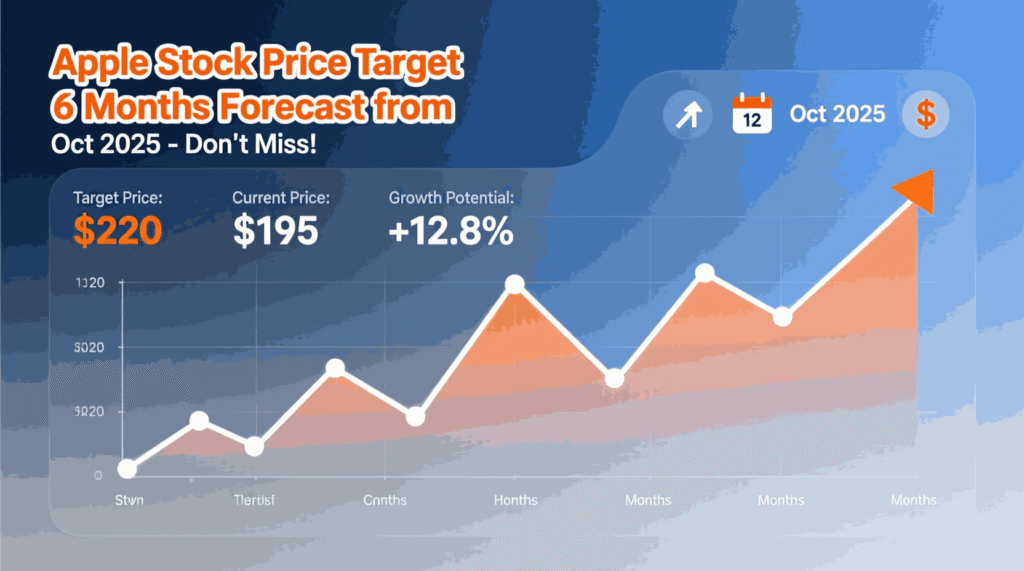
Apple Stock Price Target 6 Months Forecast from November 2025, Don’t Miss!

“Apple stock price target 6 months” is a micro research attempt to provide an estimated price target for APPLE stock for the next 6 months. Introduction & Approach Forecasting stock prices over short to medium time frames is inherently speculative, especially in a volatile technology sector. That said, analysts, quant models, and pundits often publish 12-month or multi-year targets, which we can draw on and then interpolate month-wise, adjusting for momentum, seasonality, and judgment. In this blog, I take the following steps: Because many forecasts are for 12 months or beyond, the month-wise breakdown is somewhat artificial — but it serves to show what might be expected under “linear” or “nonlinear” paths. Recent Analyst / Market Sentiment on Apple Here is a summary of key recent views and forecasts for AAPL: Analyst / Source Target / Forecast Key Rationale / Notes Source URL Wedbush / Dan Ives $310 (raised from $275) Belief in a consumer upgrade cycle, strong AI push, large installed base of iPhones “Apple stock forecast … says the tide is turning” (TipRanks) Jefferies $205.82 (raised from 190.67) Tariff relief, AI potential, but cautious tone “Jefferies raises Apple stock price target to $205.82” (Investing.com) Morgan Stanley ~$252 (cut from $275) Slower AI ramp, valuation concerns, delayed Siri features See Investors.com note on price target cut (Investors.com) JPMorgan (Samik Chatterjee) $230 (revised down from $240) Keeps overweight but more conservative target “Apple Stock Gets Price-Target Cut …” (Investors.com) MarketBeat consensus / aggregated ~$245–$250 Average of many analysts “According to the 34 analysts’ 12-month price targets … average $245.66” (MarketBeat) ValueInvesting.io $247.07 Consensus among ~55 analysts “average stock forecast … next 12 months” (Value Investing) CoinCodex / Quant models Varied monthly forecasts Gov Capital: average ~$229.90 for October, $238.90for for November, etc. LiteFinance (analysts opinions) Gov Capital: average ~$229.90 for October, $238.90for for November, etc. They publish monthly model breakdowns for 2025 (LiteFinance) From this, one can see a wide dispersion: a highly bullish view (Ives’ $310) vs more cautious ones in the low $200s. The consensus (mid ~$240–250) seems a reasonable “base case” anchor. I will adopt three scenarios: Then I will map these into 6-monthly points (Oct 2025 – Mar 2026), with some nonlinearity (e.g., seasonality around year-end, new product cycles) built in. Month-Wise 6-Month Price Target Projection (Base Case) Methodology / Assumptions So here is my projected month-by-month table (with three scenarios): Month (2025-2026) Base Case Target Bull Case Target Bear / Cautious Target Comments / Key Risks October 2025 $258.0 $270.0 $250.0 If Google is still busy in AI arena, No positive pixel news. November 2025 $262.5 $280.0 $255.0 Holiday and upgrade anticipation December 2025 $265.0 $290.0 $258.0 Apple often sees year-end strength January 2026 $267.5 $295.0 $260.0 Post-holidays, smoothing February 2026 $270.0 $300.0 $265.0 If upgrades / AI news are positive March 2026 $272.5 $305.0 $270.0 If Google is still busy in the AI arena, no positive pixel news. April 2026 $275.5 $315.0 $274.5 Close to full 6-month ramp We can also show this projected path in a simple line for visualization (though textual here). Interpretation & Sensitivities One might also apply a momentum “accelerator” factor, e.g., toward year-end or right after earnings or product events. For instance, if Apple unveils a surprise AI hardware feature, the stock could overshoot. If one wanted, one could also impose a volatility corridor (±5–10%) around each monthly target as a band of uncertainty. Extended Table with Commentary & Analyst Overlay Let me expand the table with a column linking to what analysts might expect in that period, and caveats. Month Base Bull Bear Analyst / Model Support & Risks Oct 2025 $258.0 $270.0 $250.0 CoinCodex forecasts average ~$ 265.72 for October 2025 (CoinCodex). If early quarter guidance or product leaks disappoint, downside risk exists. Nov 2025 $262.5 $280.0 $255.0 Seasonal strength may help. But if consumer demand softens, the cautious path may dominate. Dec 2025 $265.0 $290.0 $258.0 Apple’s holiday quarter and new product announcements often drive upside. But supply constraints or macro weakness could drag. Jan 2026 $267.5 $295.0 $260.0 January is often quieter. Bull case assumes strong momentum carryover; bear case sees consolidation. Feb 2026 $270.0 $300.0 $265.0 By March, much of the 6-month movement may be realized. The bull case edges toward ~20% gain, consistent with Ives’ long-run target. Mar 2026 $272.5 $305.0 $270.0 By March, much of the 6-month movement may be realized. The bull case edges toward ~20% gain, consistent with Ives’ long run target. Given more data (quarterly earnings, macro trends, AI news), one could adjust this path month to month. Comparison with Analyst 12-Month Targets & Extrapolation Let’s see how my 6-month projection stacks relative to various 12-month targets and what it would imply for months beyond. If Apple follows my base case through March 2026, one might then expect the remaining 6 months to continue at a slower clip, potentially reaching ~$285–290 by the end of 2026 (if momentum holds) or flattening near $275–280 under more cautious views. Also Read | IPO Analysis 2025 Risks, Catalysts & Adjustments Any forecast must also address risks and catalysts that could push the stock off the projected path: Catalysts (Upside) Risks (Downside) Because of these, actual monthly outcomes might deviate by ±5–10% or more from the “baseline” target. Narrative Walkthrough: Month by Month Let me walk through what might happen each month in this path: If Apple beats on earnings or surprises with AI/hardware, the stock could overshoot this path. Conversely, if guidance is tepid, pullbacks may happen. Sensitivity & Alternate Scenarios To provide a more robust view, one can imagine bands around the base path, e.g.: Thus, while the base case is a steady climb, one must be ready to adapt. Conclusion & Takeaways Apple stock price target 6 months Bharatsharebaz.com

HDB Financial Services IPO Risks
News, Research

HDB Financial Services IPO Risks: RBI’s 94% Stake Threat, ₹1 Lakh Crore OFS Trap & Rising Bad Loans – Protect Your Money NOW!

Investing in an IPO is exciting, but it’s important to go beyond the hype. HDB Financial Services, backed by HDFC Bank, is entering the public markets. While the buzz is strong, the Red Herring Prospectus reveals several key risks that retail investors need to understand. We’ll break HDB Financial Services IPO Risks down in simple terms, with Indian market examples and beginner-friendly explanations “IPOs are like arranged marriages – you see the résumé, not the hidden debts.”– Old Dalal Street Proverb Brace yourself for India’s most conflicted IPO of 2025. In this article – “HDB Financial Services IPO Risks” We will try to figure out and understand the risks and its mitigations. HDFC Bank’s ₹2.1 lakh crore shadow-lending arm, is hitting the market with two faces: Why this feels like déjà vu: In this analysis, we’ll expose: ☠️ The ₹100,000 Cr OFS Illusion (Hint: Zero rupees reach HDBFS) 📉 Why bad loans doubled as India celebrated 8.2% GDP growth 🕒 The 2028 brand expiry bomb nobody’s discussing ⚖️ RBI’s draft circular – the sword hanging over 94% promoter ownership “When elephants dance, mice get trampled. But what if the elephant is forced to exit the stage?” This isn’t just another NBFC IPO. It’s a high-stakes gamble on regulatory mercy, collateral cracks, and HDFC’s fading halo. If possible please read the Red Herring Prospectus RBI’s new rule might force HDFC Bank to sell most HDB Financial Services shares → Share prices could tank. Scary! “In India, banking and regulation dance like scorpions in a bottle.” Imagine RBI as that strict teacher who suddenly changes exam rules after you’ve studied. Their October 2024 draft circular wants banks and their group companies to stop overlapping businesses. HDBFS sells loans just like HDFC Bank. The RBI is drafting rules (Oct 2024) saying banks and their group companies can’t do the same core business. HDBFS and HDFC Bank both offer loans! The RBI could force HDFC Bank to slash its stake in HDBFS to below 20% within 2 years! Imagine the selling pressure! Think Ujjivan Small Finance Bank. Its parent (Ujjivan Financial Services) had to drastically reduce its stake post-listing due to regulatory requirements, creating significant uncertainty and impacting the share price trajectory initially. Investor Takeaway: “Never ignore RBI’s shadow. Ask Paytm shareholders about their ‘VIP lounge’ in the loss-making zone.” The NPA Ticking Bomb: Bad Loans Are Breeding Gross Stage 3 loans (fancy term for NPAs) rose from 1.90% → 2.26% in just 1 year. Provisions doubled (+97%!) to ₹2,113 Cr. Mitigation? “We have policies!” says HDB Financial Services“So did Yes Bank,” mutters the market. 😬 The OFS Illusion: ₹1 Lakh Crore Vanishing Act The biggest chunk of this IPO? An Offer For Sale (OFS). Translation: Cold Truth: “OFS IPOs are exit routes for promoters, not growth rockets for companies.” Asset-Liability Mismatch: Borrowing Short, Lending Long This is like taking a 1-year FD from grandma to fund your cousin’s 10-year farmhouse loan. Street Wisdom: “ALM mismatches sink ships faster than icebergs. Ask any DHFL bondholder.” The Brand License Trap: HDFC’s Logo Isn’t Forever HDBFS uses HDFC Bank’s brand. License expires July 2028. Investor Joke: “Building a brand takes decades. Losing it? RBI can do it in 1 circular.” The BPO Dependency: 2.4% Profits Hang by a Thread HDBFS does back-office work for HDFC Bank. Tiny slice? Yes. But if cut, it’s a reputation earthquake. Lesson: “Promoter giveth, regulator taketh away.” The Verdict: To Bid or Not to Bid? Bull Case: Bear Case: Nearly 27% of HDB’s loans are unsecured. Risk: These are loans without collateral. If customers default, recovery is very difficult. Soros Wisdom: “It’s not whether you’re right or wrong, but how much you make when right & lose when wrong.” Apply Here: Your Survival Toolkit for HDB Financial Services IPO Risks Final Chai-Stall Wisdom:“In India, IPOs are like monsoon weddings. Glamorous, crowded… but check if the roof leaks before you buy the gift.” 😉 Disclaimer Investing in IPOs can feel exciting, especially for new investors, but it’s important to understand the risks involved. The content on this website is meant to help you learn and make sense of IPOs, but it’s not financial advice. We explain things in an easy way, but we don’t suggest or recommend any specific stock or investment. IPOs are unpredictable. Prices can move up or down quickly after listing, and there’s no guarantee you’ll make a profit. Unlike established companies, IPOs have very little past data to study, which makes it harder to judge how well they might do in the future. The performance of an IPO can also be affected by the overall stock market. Even strong IPOs may suffer if the market is down. That’s why doing your own research is very important. Always read the red herring prospectus, try to understand the company’s business and financials, and look at the risks and opportunities in its industry. A good management team and a solid business model matter too. We highly recommend speaking with a SEBI-registered financial advisor before making any investment decisions. They can help you plan based on your personal needs, goals, and how much risk you’re comfortable with. Just because an IPO did well in the past doesn’t mean it will happen again. All investment decisions you make are your own, and we are not responsible for any loss that may occur. By using this website and reading IPO-related content, you agree to this disclaimer and understand the risks involved. I short, If you are absolute beginner then, As a beginner: Sign up for free updates and insights! Bharatsharebaz.com

ipo 2025 analysis
Research

IPO 2025 Analysis: Hope, Risks, and What Investors Need to Know

IPO Market 2025: Cautious Optimism Amidst Selective GrowthThe IPO market is stirring back to life. Analysts predict 2025 could rival 2024’s performance, but challenges persist. Let’s break down the trends, data, and expert insights shaping this year’s landscape in the article “IPO 2025 Analysis: Hope, Risks, and What Investors Need to Know” Stock Investment DisclaimerThe information provided here is for educational and informational purposes only. It does not constitute financial advice, investment recommendation, or an endorsement of any security, company, or strategy. Investments in securities markets are subject to market risks. Read all related documents carefully before investing. 2024 IPO Performance Recap A Sharebaz analysis of 101 IPOs since January 2024 reveals mixed results: Top Underperformers (as of May 2025): Company Return (%) Ola Electric -32.74 Swiggy -20.14 Hyundai -7.12 NTPC Green Energy -4.64 Top 2024 IPOs by Size: Company Issue Size (₹ crore) Issue Price (₹) Hyundai Motor India 27,858.75 1,960 Swiggy 11,327.43 390 NTPC Green Energy 10,000 108 You may also like HDB Financial Services IPOs Risks IPO 2025 Trends: Slow Start, Brighter Horizons 2025 began cautiously: Nirav Karkera: “Last year ended with a few big IPOs, but many others were shelved. Firms now see improving conditions and are warming up to return.” Despite muted enthusiasm, sectors like renewable energy and quick commerce remain investor favorites. High-profile names like Reliance Jio, LG Electronics, and fintechs Groww and PhonePe are eyeing 2025 listings. IPO 2025 Expert Insights: Valuation Realities Deepak Jasani: “Merchant bankers often prioritize high valuations to secure mandates. This can overshadow long-term investor outcomes.” Nirav Karkera: “Even strong fundamentals struggle post-listing. Swiggy and Hyundai had massive hype but couldn’t sustain momentum.” Standout Performers Company Return (%) Jyoti CNC Automation 267.27 KRN Heat Exchanger 251.64 Bharti Hexacom 193.41 IPO 2025 analysis: Market Sentiment & Challenges Deepak Jasani: “Retail investors lack tools to assess valuations deeply. They chase hype but exit quickly if sentiment dips.” The Road Ahead Nirav Karkera: “Conditions aren’t perfect but are conducive. Firms reinvesting in growth will lead the charge.” Key Takeaway: Discipline is critical. Focus on companies with clear profitability paths—speculative plays face resistance. Data as of May 22, 2025. Sources: Sharebaz, Prime Database. Stay informed. Invest wisely. source: moneycontrol.com Bharatsharebaz.com

Scroll to Top